


















The Israeli Flag: Design, Meaning and History
The flag of Israel is two blue stripes on white with a blue Star of David between them. It looks simple, and the simplicity is deliberate: it is not heraldry borrowed from a dynasty or an empire. It is a prayer shawl.
What the Israeli Flag Looks Like
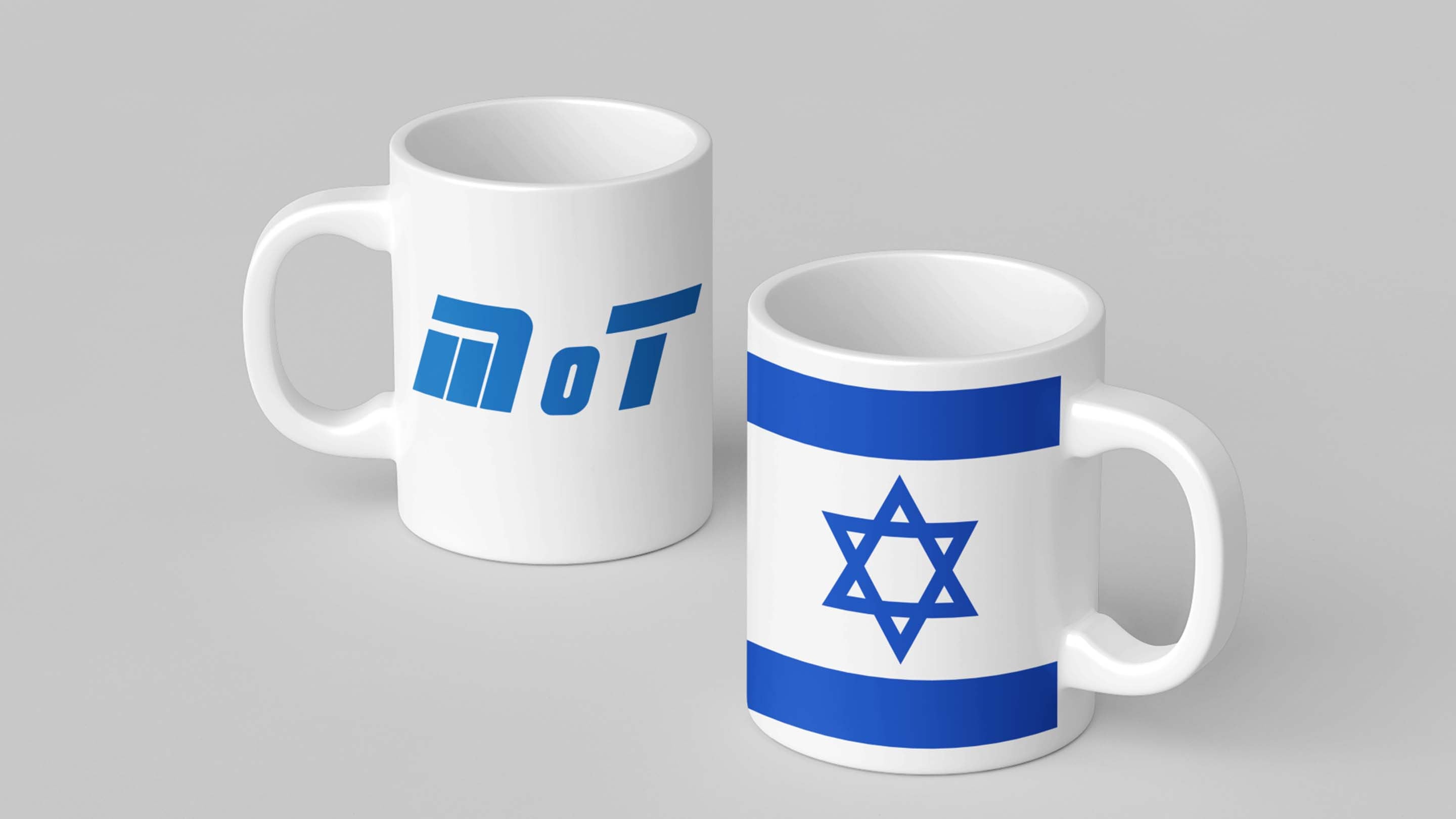
The proportions are 8:11, which is unusually elongated among national flags. The field is white. Two horizontal blue stripes run near the top and bottom edges, and a blue Magen David sits in the centre.
The blue is officially described as dark sky-blue. In practice the shade has varied considerably over the decades, from pale to near navy, and Israeli law does not fix a precise colour value.
What the Flag Means
The Stripes Are a Tallit
The two stripes are drawn from the tallit, the Jewish prayer shawl, which is traditionally white with dark blue or black stripes. This is the whole idea of the flag: rather than take its imagery from a royal house or a military order, as most European flags do, Israel took it from an object used in daily prayer.
The poet Ludwig August Frankl expressed it in 1860, in a poem describing the colours of the land of Judah as white and blue, white for the light of faith and blue for the splendour of the firmament. The verse circulated widely and shaped what came next.
The Star of David
The Magen David had become the standard Jewish symbol during the nineteenth century. Placing it at the centre made the flag unmistakably Jewish without tying it to any one religious movement or political faction.
Blue and White in the Bible
The colour tekhelet, a blue dye specified in the Torah for the fringes of the tallit, gives the blue an older layer of meaning. The source of the dye was lost in late antiquity, which is why most tzitzit are white today, but the association survived in the striped shawl and from there reached the flag.
History of the Flag
Before the State
A blue and white flag with a Star of David was flown by Zionist groups from the 1880s onwards. Versions appeared in Rishon LeZion in 1885 and at Boston's B'nai Zion association in 1891.
The design was formally adopted by the First Zionist Congress in Basel in 1897, and again at the Eighteenth Congress in Prague in 1933, where it was confirmed as the flag of the Zionist movement.
Adoption by the State
Israel declared independence on 14 May 1948, but did not immediately adopt a flag. There was genuine hesitation: using the Zionist movement's banner as a state flag risked implying that Jews living elsewhere owed allegiance to Israel rather than to their own countries.
After public consultation the design was adopted by the Provisional Council of State on 28 October 1948, five months after independence. The only change from the Zionist flag was a slight darkening of the blue.
The Flag and the Emblem Are Different
A point that often causes confusion: the flag carries the Star of David, but the state emblem carries the seven-branched menorah flanked by olive branches, with the word Israel beneath.
The menorah is much the older symbol, going back to the Temple in Jerusalem. The emblem's design is based on the menorah carved on the Arch of Titus in Rome, which was made to commemorate the destruction of that Temple. The two symbols divide the work: the star on the flag, the menorah on the seal.
Common Questions
What do the blue and white on the Israeli flag mean?
They come from the tallit, the prayer shawl. White is traditionally read as purity and light, blue as the sky and as the biblical tekhelet dye.
When was the Israeli flag adopted?
On 28 October 1948, five months after the declaration of independence. The design itself dates to the 1890s and was used by the Zionist movement from 1897.
Who designed the Israeli flag?
There is no single designer. The blue and white striped flag with a Star of David emerged from several groups in the 1880s and 1890s. David Wolffsohn is often credited with presenting the version used at the 1897 Congress, drawing directly on the tallit.
Is the Israeli flag the same as the Jewish flag?
No. The flag of Israel is the flag of a sovereign state. Jews outside Israel are citizens of their own countries, and the flag does not represent them politically. It is nevertheless often flown at Jewish community events as a gesture of solidarity.
What are the proportions of the Israeli flag?
Officially 8:11, making it noticeably longer relative to its height than most national flags, which are typically 2:3 or 3:5.
Why is there no fixed shade of blue?
Israeli law describes the colour without specifying an exact value, so manufactured flags vary from light to dark blue. Both are considered correct.
Wearing the Flag
Since October 2023 the flag has been worn far more visibly across the diaspora, on clothing, at rallies and at community events. For many it functions less as a statement about any particular government and more as a signal of belonging and of refusal to be invisible.
Our Israel flag apparel collection carries flag designs across t-shirts, hoodies, swimwear and accessories, alongside our IDF and Israel army apparel.
From the MoT Shop
We print Jewish and pro-Israel designs to order and ship worldwide. Browse our Israel flag apparel, our Star of David and Jewish symbols collection, or read our guide to Jewish holiday dates.